
You found a good retail building or strip center. Then the records show that one unit was a dry cleaner. The deal is not dead. But you need facts before you close. This guide explains why a former dry cleaner matters, what the testing looks for, and which Washington cleanup levels apply.
The short version
- The concern is tetrachloroethylene. It is also called PCE, perc, or perchloroethylene.
- PCE is heavier than water. It can move down through soil into groundwater.
- PCE vapors can move from the ground into a building.
- A Phase I ESA finds the history. A Phase II ESA tests soil, groundwater, and soil vapor.
- Washington’s Method A cleanup levels for PCE are 5 ug/liter in groundwater and 0.05 mg/kg in soil.
- Ecology says contamination from dry cleaning is typically eligible for its Voluntary Cleanup Program.
Why PCE matters
The Agency for Toxic Substances and Disease Registry (ATSDR) describes tetrachloroethylene as a manufactured chemical used for dry cleaning and metal degreasing. It is a nonflammable, colorless liquid.
ATSDR also reports how agencies classify it. EPA considers tetrachloroethylene likely to be carcinogenic to humans by all routes of exposure.
Two more facts from ATSDR explain why an old release can still be there:
- PCE may evaporate quickly from shallow soils, or it may filter through the soil and into the groundwater below.
- PCE is generally slow to break down in soil and in water.
So the date the cleaner closed does not answer the question. Only site data does.
Why liability matters to a buyer
Washington’s cleanup law is the Model Toxics Control Act (MTCA). RCW 70A.305.040 says each liable person is strictly liable, jointly and severally, for all remedial action costs. A new owner can become part of that group. Ask your attorney how the law and its defenses apply to your purchase.
How PCE moves
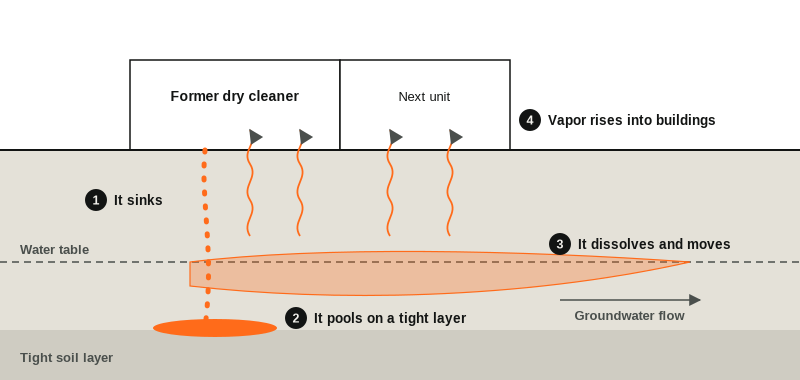
Two pathways matter most.
It sinks
EPA groups tetrachloroethene with the dense nonaqueous phase liquids, or DNAPLs. EPA says these liquids are heavier than water and only slightly soluble in water. When enough is released, the liquid can move down through soil and groundwater. It stops when it meets a layer that resists it, and it can pool there.
EPA also says the path can be complex, because the liquid follows the path of least resistance. So shallow soil samples alone may not find the problem.
It becomes vapor
EPA says vapor intrusion occurs when vapor-forming chemicals move from a subsurface source into an overlying building. EPA names chlorinated solvents as one of the chemical groups of concern. Its diagram shows vapors that enter through cracks in the foundation and openings for utility lines.
Ecology gives the same warning. It says vapors from contaminated soil or groundwater can migrate into buildings and can cause unhealthy levels of hazardous substances in indoor air.
What a Phase I looks for
A Phase I Environmental Site Assessment is a records and site review. It does not collect samples. The federal rule for all appropriate inquiries, 40 CFR 312.20, lists what the inquiry must include. Some of the items are:
- Interviews with past and present owners, operators, and occupants.
- Reviews of federal, tribal, state, and local government records.
- Visual inspections of the property and of adjoining properties.
The federal rule names ASTM E1527-21 as a standard that meets these requirements.
For a former dry cleaner, a good Phase I answers practical questions:
- Which unit held the cleaner, and for which years?
- Was cleaning done on the property, or was it a drop-off counter only?
- Which solvent did the cleaner use?
- Where were the machine, the solvent storage, and the waste storage?
- Where are the floor drains and the sewer line?
- Are there agency records of a release or a cleanup at this address or next door?
If the answers leave a concern, the report lists a recognized environmental condition (REC). You can check a report that you already have with the Phase I report reader.
Timing matters too. Under 40 CFR 312.20, the inquiry must be done within one year before the purchase date. Some parts, such as the interviews, the records review, and the visual inspection, must be done or updated within 180 days before that date.
See our Phase I Environmental Site Assessment service.
What a Phase II tests
A Phase II ESA collects samples and sends them to a lab. At a former dry cleaner, three kinds of samples are common.
| Sample | What it shows | Why it matters for PCE |
|---|---|---|
| Soil | Whether solvent is in the soil, and how deep | PCE can move down through soil |
| Groundwater | Whether solvent reached the water | PCE is heavier than water and slow to break down |
| Soil vapor under the slab (sub-slab vapor) | Whether solvent vapor is below the floor | Vapors can enter the building through cracks and utility openings |
Vapor sampling under Ecology’s guidance
Ecology publishes “Guidance for Evaluating Vapor Intrusion in Washington State: Investigation and Remedial Action.” It is publication 09-09-047. Ecology first published it in January 2009 and revised it in March 2022.
Ecology says the guidance gives a practical approach for sites where volatile chemicals in the subsurface might pose a threat to indoor air quality. It contains:
- A process to evaluate the vapor intrusion pathway.
- Methods for soil gas, indoor air, crawl space, and ambient air sampling.
- References to screening levels for soil, groundwater, and soil gas, and to indoor air cleanup levels.
- Mitigation measures to protect the people in the building.
Ask your consultant to follow this guidance. See our vapor intrusion assessment service.
Washington’s Method A cleanup levels for PCE
The lab results are compared to cleanup levels in the MTCA rule. WAC 173-340-900 holds the Method A tables. These are the values for tetrachloroethylene, as the tables state them.
| Table | Medium | Method A cleanup level for tetrachloroethylene |
|---|---|---|
| Table 720-1 | Groundwater | 5 ug/liter |
| Table 740-1 | Soil, unrestricted land uses | 0.05 mg/kg |
The table notes explain the basis. The groundwater level is based on applicable state and federal law. The soil level is based on protection of groundwater for drinking water use.
The soil level is set to protect groundwater, not only the soil itself.
Read the caution in the tables
Both tables start with a caution on misuse. The rule says the tables give conservative cleanup levels for sites with routine cleanup actions or with relatively few hazardous substances. It says the values should not automatically be used to define the cleanup levels for real estate or financial transactions. It also says that an exceedance does not necessarily mean the soil or groundwater must be restored to those levels at every site.
So treat Method A as the first comparison. Your consultant will tell you whether another method applies to the site. Vapor results use a different comparison. Ecology’s vapor intrusion guidance refers to the screening levels for that pathway.
If the Phase II finds PCE
You still have choices. You can collect more data, ask the seller to act, change the deal terms, buy and manage the cleanup, or walk away. Your attorney and lender should help you weigh them. Our guide on what to do when a Phase I finds a REC compares these options.
Reporting
WAC 173-340-300 says an owner or operator must report a release that may pose a threat to human health or the environment to Ecology within 90 days of discovery. The rule gives examples of what an owner should generally report. Two of them fit dry cleaner sites: vapors in a building that appear to come from contaminated soil or groundwater, and a chlorinated solvent as free product. Ask your attorney who must report and when.
The Voluntary Cleanup Program
Ecology’s Voluntary Cleanup Program (VCP) gives written opinions on independent cleanups. Ecology’s VCP page says contamination from dry cleaning, automotive repair, and spills is typically eligible. Other conditions apply. For example, the contamination must not pose a significant or immediate risk to people or other living things.
When a site meets all cleanup requirements, Ecology says it will issue a No Further Action opinion. Read how the VCP and No Further Action work.
A different rule applies to fuel. Petroleum released from a tank system goes to a different agency. Read about the PLIA Technical Assistance Program.
Questions to ask before you close
- Does the Phase I name the cleaner, the unit, and the years of operation?
- Did the Phase II test soil, groundwater, and soil vapor, or only one of them?
- How deep did the soil and groundwater samples go, and why?
- Were the results compared to the Method A levels and to vapor screening levels?
- Do the neighbor units share the slab or the sewer line?
- Can your lender rely on the reports?
Next step
Sort your findings with the Phase II checker. Then see our Phase II Environmental Site Assessment service and our page on dry cleaners and laundromats. Kee Enviro works on commercial properties in Washington and Oregon. This article covers Washington rules. To talk through your site, contact us or call our Federal Way office at 206-914-4989.