
You open a Phase I ESA and turn to the conclusions. You see the letters REC, CREC, or HREC. These three terms decide what happens next in your deal. This guide explains each one in plain language. It is general information, not legal advice.
The short version
A REC is a sign of a release, or a likely release, that is not resolved. A CREC is a release that was addressed, but controls stay on the property. An HREC is a past release that was closed with no controls. A de minimis condition is a minor item that is not a REC.
The finding types side by side
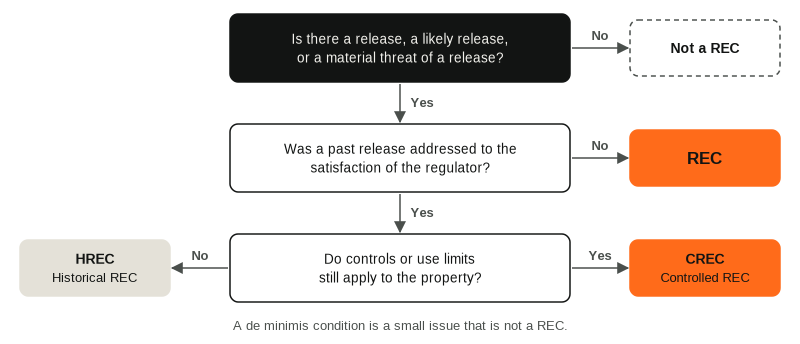
All of these terms come from ASTM E1527-21. That is the Phase I standard that EPA recognizes for the federal all appropriate inquiries rule.
| Finding | Plain meaning | Listed in the report conclusions? | What a buyer or lender usually does |
|---|---|---|---|
| REC | A release, a likely release, or a material threat of a future release | Yes | Decides whether to test with a Phase II ESA |
| CREC | A release that a regulator accepts as addressed, with contamination left in place under controls | Yes | Reads the controls and plans to comply with them |
| HREC | A past release closed to unrestricted use standards, with no controls | Not in the standard conclusion statement | Confirms that the report checked the old closure |
| De minimis condition | A minor item that generally poses no threat | No, it is not a REC | Usually no action |
| Significant data gap | Missing information that limits the opinion | Yes | Asks if the gap can be closed |
What is a recognized environmental condition?
ASTM E1527-21 says that the goal of a Phase I is to identify RECs. The definition has three parts. We paraphrase them here.
- A known release. Hazardous substances or petroleum products are present in, on, or at the property because of a release to the environment.
- A likely release. These substances are likely present because of a release or a likely release.
- A material threat. The substances are present under conditions that pose a material threat of a future release.
What “likely” means
A note in the standard explains the word. “Likely” means not certain and not proved. But a reasonable observer can expect it, based on the logic and experience of the environmental professional and the evidence in the report.
Examples from the standard
Appendix X4 of the standard gives examples and a decision diagram. One law firm summary describes them this way.
- A property was a gas station or a dry cleaner for many years before modern rules. That use can be a REC because a release is likely.
- An old bare-steel underground tank with no leak detection can be a REC for the same reason.
- Drums stacked in an unsafe way, or a bulging tank, can be a material threat of a future release.
See our pages on gas stations and dry cleaners and laundromats for more on these property types.
What is a CREC?
CREC means controlled recognized environmental condition. It is a REC with three features:
- A regulator is satisfied with how the release was addressed.
- Hazardous substances or petroleum products remain in place.
- The property must follow required controls. Examples are activity and use limitations.
What a CREC means for you
A CREC is still a type of REC. The report must list it in the conclusions. The environmental professional must also identify the documents that set the controls.
The professional does not confirm that the controls work. The standard says that a CREC finding does not mean anyone evaluated the adequacy or the continued effectiveness of the controls. Read the control documents with your attorney. Ask what the controls require of an owner and what your planned use needs.
What is an HREC?
HREC means historical recognized environmental condition. It is a past release that meets these tests:
- A regulator is satisfied with how the release was addressed.
- The property meets the regulator’s criteria for unrestricted use.
- No controls apply to the property.
A common example is a tank that leaked and was removed. The owner dug out the affected soil. The regulator then issued a closure letter with no use limits.
Old closures need a second look
A closure letter alone is not enough. Under E1527-21, the environmental professional must review the data behind the old closure. The professional checks whether the data meet current standards for unrestricted use. Standards change over time. An old closure that does not meet current standards can be a REC today.
What is a de minimis condition?
A de minimis condition is related to a release, but it is minor. It generally does not present a threat to human health or the environment. It generally would not lead to an enforcement action if an agency knew about it.
ASTM E1527-21 states that a de minimis condition is not a REC. The report still describes it. The report should also give the reason why each finding is, or is not, a REC, a CREC, an HREC, or a de minimis condition.
What is a business environmental risk?
Some issues can affect your deal but are outside the Phase I standard. ASTM calls this group business environmental risk, or BER. The standard lists examples in a section on non-scope considerations.
Law firm summaries name asbestos, lead, radon, and wetlands as common non-scope items. Emerging contaminants can also be non-scope when federal Superfund law does not list them as hazardous substances.
A BER item is not a REC. It can still cost money or limit your plans. ASTM says that you and the consultant should agree on any added services before the work starts. Tell your consultant early if you plan to renovate, demolish, or redevelop.
What about significant data gaps?
A data gap is information that the consultant could not get, even with a good faith effort. E1527-21 defines a significant data gap as one that affects the ability to identify a REC. An example is a building that the consultant could not enter during the site visit.
The report conclusions list significant data gaps next to RECs and CRECs. Ask your consultant if more access or more records can close the gap.
What each finding means for a buyer or lender
In Washington, the Model Toxics Control Act makes cleanup liability strict, joint, and several. A buyer can be liable for contamination that a past owner caused. The label on each finding helps you decide how much risk remains.
- REC. The federal rule asks the report to include an opinion on additional appropriate investigation, if any. That opinion often points to a Phase II ESA. A lender may ask for testing as a loan condition.
- CREC. Plan to follow the controls. Check that your intended use fits them.
- HREC. Confirm that the report compared the old closure to current standards.
- De minimis condition. Usually no more work is needed.
- BER item. Decide with your attorney and lender if you want it studied.
Kee Enviro works on commercial properties in Washington and Oregon. To compare the two types of assessment, see Phase I vs Phase II ESA. For the steps after a REC, read what to do when a Phase I finds a REC.
Next step
Upload your report to the Phase I report reader to see the findings in plain language. If you need a new report or a second opinion, see our Phase I Environmental Site Assessment service or contact Kee Enviro.