
A Phase I ESA is not only the consultant’s job. The federal rule gives the buyer duties too. If you skip them, your report can have a gap. This checklist shows what the rule asks of you and which documents help your consultant. It is general information, not legal advice.
The short version
Send two groups of items. The first group is your answers to four questions that the federal rule assigns to the buyer. The second group is practical: old reports, site plans, a tenant list, and a contact who can open every door.
Who is the “user”?
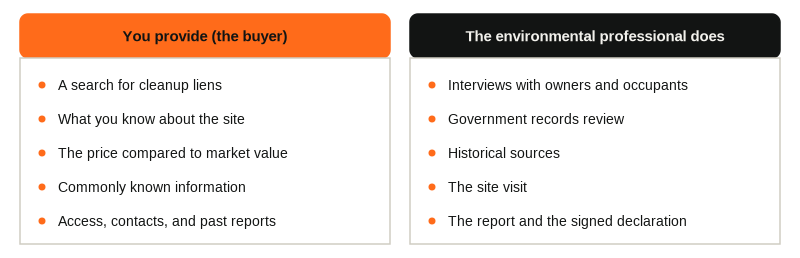
ASTM E1527-21 uses the word “user” for the party that the report is prepared for. In a purchase, the user is usually the buyer.
The federal all appropriate inquiries (AAI) rule is 40 CFR Part 312. It applies to a person who wants one of three federal liability protections: the innocent landowner defense, the bona fide prospective purchaser protection, or the contiguous property owner protection.
The rule has three main parts. The first part is the inquiry by the environmental professional. The second part is the information that the buyer collects under section 312.22. The third part is the search for recorded environmental cleanup liens.
The four duties of the buyer under 40 CFR 312.22
| Duty | Rule section | What you do | What to send |
|---|---|---|---|
| Environmental cleanup liens | 312.25 | Search for cleanup liens filed or recorded against the property | The title report or lien search, or a request for the consultant to do the search |
| Specialized knowledge | 312.28 | Take into account what you know about the property, the area, and the adjoining properties | A short written note of what you know |
| Purchase price and fair market value | 312.29 | Consider whether the price reasonably reflects the value of the property if it were not contaminated | A yes or no, and the reason if the price is low |
| Commonly known information | 312.30 | Take into account what is commonly known in the local community about the property | Anything you heard or read about past uses, spills, or cleanups |
1. Environmental cleanup liens
The rule requires a search for environmental cleanup liens that are filed or recorded under federal, tribal, state, or local law. The buyer does this search unless the environmental professional obtains it. ASTM E1527-21 calls the lien search a user responsibility.
Under the ASTM standard, you can use title insurance documents, such as a preliminary title report or a title commitment. You can also use a separate title search report. That type of report must review land title records from 1980 to the present. A search that goes back only to the last sale is not enough.
The lien search has a time limit. It must be done or updated within 180 days before the date you buy.
2. Specialized knowledge
You may know things that the consultant does not. Examples are experience in the same industry, past work near the site, or knowledge of a neighbor’s operations. The rule says that all appropriate inquiries are not complete unless they take this knowledge into account.
3. Purchase price and fair market value
Ask one question. Does the price reasonably reflect the fair market value of the property, if it were not contaminated? If the price is lower, you must consider whether contamination is the reason.
ASTM E1527-21 suggests that you tell the consultant when the price is lower because of contamination. You are not required to disclose the purchase price.
4. Commonly known information
The rule asks you and the consultant to consider what the local community knows about the property. The rule lists examples of sources: neighbors, local and state officials, other people with knowledge of the property, newspapers, websites, community groups, libraries, and historical societies.
You do not need to do a research project. Tell the consultant what you know or have heard.
The user questionnaire
ASTM E1527-21 includes an optional user questionnaire in Appendix X3. Many consultants send it, or a form like it, at the start. It collects the four items above in one place. Answer each question and return the form before the site visit.
Under the ASTM standard, if you do not share this information, the consultant should consider what the missing information means for the report.
Practical documents that help
No rule lists these items as buyer duties. But they make the report faster and more complete.
Property records
- Address, tax parcel numbers, and a legal description
- A site plan, survey, or as-built drawings
- Building age, size, and current use
- Your planned use, such as renovation, redevelopment, or a change of use
Past environmental work
- Prior Phase I and Phase II reports
- Tank records, such as removal or closure reports
- Cleanup reports and agency letters
- Any environmental covenant or use limit that you know about
- Asbestos or lead surveys, if the seller has them
The federal rule lets a new assessment use information from an earlier one, with conditions and time limits. Old reports are still useful as background. See how long a Phase I ESA is valid.
People and access
The rule requires interviews with the current owner and occupant. If a property has several occupants, the professional interviews the major ones. The professional also interviews occupants who are likely to use or store hazardous substances.
Send these items:
- A tenant list with the business type of each tenant
- A name and phone number for the owner
- A name and phone number for the property manager or key site contact
- An access contact who can open all units, roofs, basements, and locked rooms
Access matters. The rule requires a visual inspection of the property and its facilities. A seller’s refusal to give access does not excuse the inspection. A locked room can also leave a data gap in the report.
Deal details
- The closing date and the end of your due diligence period
- Your lender’s name and its report requirements
- The names of every party that must be able to rely on the report
Timing
The date you buy controls the clock. The rule defines the date of acquisition as the date you acquire title. The whole assessment must be done within one year before that date. Five parts must be done or updated within 180 days before it. These are the interviews, the lien search, the government records review, the site visit, and the professional’s declaration.
Many Phase I reports take two to three weeks. Slow access and late documents add time. Use the due diligence timeline to plan back from your closing date.
Common mistakes
- No lien search. Each side thinks the other did it. Confirm who does the search in the proposal.
- A blank user questionnaire. The consultant cannot answer the four user questions for you.
- Old reports held back. A prior report can point to a past tank or cleanup. Send every report you have.
- No keys on the day of the site visit. Missed areas can lead to a second visit or a data gap.
- A missing party. Tell the consultant early if a lender or partner must rely on the report.
After you send the checklist
The consultant reviews the records, visits the site, and holds the interviews. The report then gives an opinion on whether the work found signs of a release. To understand the findings, read what is a REC. For what the current standard requires, read ASTM E1527-21 vs E1527-13. For budget planning, see Phase I ESA cost in Washington.
Next step
Plan your dates with the due diligence timeline. When you are ready to order, see our Phase I Environmental Site Assessment service or contact Kee Enviro. Kee Enviro works on commercial properties in Washington and Oregon.