
A Phase II ESA compares each lab result to a “MTCA cleanup level.” That number can decide if a deal moves ahead or a cleanup is needed. This guide explains where the numbers come from in Washington.
This guide is general information. It is not legal advice.
The short version
- Washington’s cleanup law is the Model Toxics Control Act (MTCA), chapter 70A.305 RCW. Its cleanup rule is chapter 173-340 WAC.
- Method A uses tables. Method B is the universal method. Method C is a conditional method that always needs restrictions on the property.
- Soil levels assume unrestricted land use unless the property qualifies as industrial.
- The Method A tables warn that their values are not automatic targets for real estate deals.
What a cleanup level is
WAC 173-340-200 defines a cleanup level as the concentration of a hazardous substance in soil, water, air, or sediment that is protective of human health and the environment under specified exposure conditions.
WAC 173-340-700 says a cleanup standard has three parts: the cleanup levels, the point of compliance where the levels must be met, and other state and federal laws that apply. The actual degree of cleanup can vary from site to site. It depends on the cleanup action that is selected.
The three methods side by side
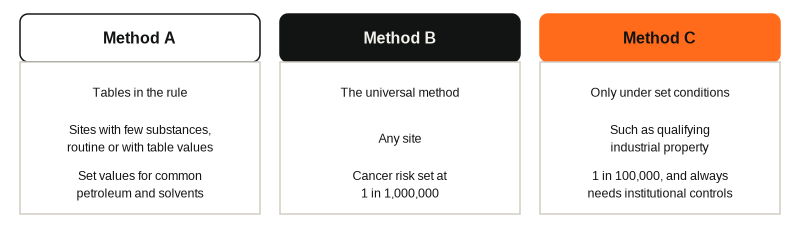
| Method | Who can use it | Cancer risk basis for one substance | Restrictions on the property |
|---|---|---|---|
| Method A | Routine cleanups, or sites with few substances that all have numerical standards | Table values and applicable laws | Not needed if the levels are met, except where WAC 173-340-440(4) requires them |
| Method B | All sites | One in one million (1 x 10⁻⁶) | Not needed if the levels are met, except where WAC 173-340-440(4) requires them |
| Method C | Only specific conditions, such as qualifying industrial soil | One in one hundred thousand (1 x 10⁻⁵) | Always required |
Method A: the tables
WAC 173-340-704 allows Method A at sites that have few hazardous substances and meet one of two tests:
- The site is a routine cleanup action, as defined in WAC 173-340-200.
- Numerical standards are available for all indicator hazardous substances in the medium.
A routine cleanup action must meet several criteria in the definition. The cleanup standards must be obvious and undisputed. The choice of cleanup method must be obvious and limited, and Ecology must have experience with it. The cleanup must not need an environmental impact statement. The site must also pass a test for terrestrial ecological evaluation.
Method A levels must be at least as stringent as the values in Tables 720-1, 740-1, and 745-1, and as applicable state and federal laws. For soil, the rule also requires a terrestrial ecological evaluation or an exclusion from one. That review can make a soil level stricter.
Method B: the universal method
WAC 173-340-705 says Method B applies to all sites. It must be used unless the conditions for Method A or Method C exist and the person doing the cleanup elects that method.
Method B uses risk equations in WAC 173-340-720 through 173-340-760. Standard Method B uses default assumptions. Modified Method B uses chemical-specific or site-specific information to change some of them.
For a single carcinogen, the level is set at an excess cancer risk of one in one million. For a noncarcinogen, the level must cause no acute or chronic toxic effects, with a hazard quotient of one. When a site has more than one substance or more than one exposure pathway, the levels must be adjusted down if the total cancer risk would exceed one in one hundred thousand or the hazard index would exceed one.
Method C: the conditional method
WAC 173-340-706 limits Method C to specific situations. For groundwater, surface water, and air, the person doing the cleanup must show that all practicable treatment methods are used, that institutional controls are in place, and that one of these conditions exists:
- The Method A or B level is below area background.
- Meeting the Method A or B level would create a significantly greater overall threat.
- The Method A or B level is below what is technically possible.
For soil, Method C is only for industrial properties that meet WAC 173-340-745. For a single carcinogen, Method C uses an excess cancer risk of one in one hundred thousand.
WAC 173-340-700 is direct on one point. A cleanup that sets Method C levels must have restrictions on the property. These restrictions are institutional controls. See environmental covenants in Washington for how they are recorded.
Unrestricted and industrial land use
The land use changes the soil numbers.
WAC 173-340-740 says residential use is generally the use that needs the most protective levels. Soil cleanup levels use that exposure scenario unless the site qualifies for industrial levels. The rule calls these unrestricted land use levels.
Industrial soil levels are in WAC 173-340-745. They are based on an adult worker exposure scenario. To use them, the area must meet the definition of industrial property in WAC 173-340-200. The cleanup must include institutional controls, at a minimum a covenant that limits the area to industrial uses. The remaining substances must not pose a threat at the site or in nearby nonindustrial areas.
Most commercial property is not automatically industrial. Ecology expects light industrial and commercial zones to qualify only where the uses are comparable to the industrial uses in the definition, or support a qualifying industrial use. The rule calls for a site-by-site review of the zoning text and the land uses.
Common Method A values for petroleum and solvents
The table below lists values from WAC 173-340-900. Groundwater values are from Table 720-1. Soil values are from Table 740-1 (unrestricted land use) and Table 745-1 (industrial properties).
| Substance | Groundwater (µg/L) | Soil, unrestricted (mg/kg) | Soil, industrial (mg/kg) |
|---|---|---|---|
| Benzene | 5 | 0.03 | 0.03 |
| Toluene | 1,000 | 7 | 7 |
| Ethylbenzene | 700 | 6 | 6 |
| Xylenes | 1,000 | 9 | 9 |
| MTBE | 20 | 0.1 | 0.1 |
| Naphthalenes | 160 | 5 | 5 |
| Gasoline range organics | 800 if benzene is present, 1,000 if no detectable benzene | 30, or 100 if the footnote conditions are met | 30, or 100 if the footnote conditions are met |
| Diesel range organics | 500 | 2,000 | 2,000 |
| Heavy oils | 500 | 2,000 | 2,000 |
| Tetrachloroethylene (PCE) | 5 | 0.05 | 0.05 |
| Trichloroethylene (TCE) | 5 | 0.03 | 0.03 |
| 1,1,1-Trichloroethane | 200 | 2 | 2 |
| Methylene chloride | 5 | 0.02 | 0.02 |
| Vinyl chloride | 0.2 | No value in the table | No value in the table |
Read the footnotes before you use any number. Two examples:
- Gasoline in soil. The 100 mg/kg level applies only if the soil is tested and has no benzene, and the total of ethylbenzene, toluene, and xylene is less than 1% of the gasoline mixture. Otherwise the level is 30 mg/kg.
- Petroleum components. The tables say you must also test for and meet the levels for other petroleum components, such as benzene and naphthalenes. Table 830-1 gives the minimum testing for each fuel type.
See our pages on gas stations and dry cleaners and laundromats.
The caution in the tables
Each Method A table starts with a footnote titled “Caution on misusing this table.” In plain terms, it says three things:
- The table gives conservative levels for routine cleanups or sites with few substances. It may not fit other sites.
- The values should not automatically be used as levels that must be met for financial, real estate, insurance, or similar transactions.
- A result above a table value does not necessarily mean the site must be restored to that value. The level of restoration depends on the remedy selected under WAC 173-340-350 through 173-340-390.
For a buyer or lender, this matters. A result above a Method A value is a signal to look closer. It is not, by itself, a cleanup decision.
What CLARC is
CLARC means Cleanup Levels and Risk Calculation. Ecology describes it as a compendium of technical information for calculating cleanup levels under chapter 173-340 WAC. It includes data tables for many chemicals.
Ecology gives these cautions on its CLARC page:
- CLARC is not required by law. Ecology provides it to help staff and the public.
- The pre-calculated standard Method B and C formula values are not cleanup levels. They do not account for applicable laws, the vapor pathway, natural background, practical quantitation limits, or total site risk.
- CLARC does not give pre-calculated values for modified Method B or C, or Method B and C values for petroleum mixtures.
- Ecology updates CLARC about every six months. Always use the most recent version.
What this means for a deal
- Buyers. Ask which method and which land use the consultant used. A comparison to industrial levels at a retail site may not hold up.
- Lenders. A cleanup with Method C levels, or with contamination left above Method A or B levels, will have institutional controls. These can limit future use and resale.
- Owners. If you plan a cleanup, the method choice affects how long restrictions stay on the property. See the Voluntary Cleanup Program and No Further Action for the process. For petroleum tank releases, read about the PLIA technical assistance program.
Our Phase II checker can help you sort Phase I findings before you test. See also Phase I vs Phase II ESA.
Next step
If your lab results exceed a MTCA cleanup level, get a clear plan before you close. See our remediation service and our Phase II Environmental Site Assessment service, or contact Kee Enviro to talk through your property.