
A Phase I or Phase II report can show contamination on a commercial property in Oregon. That does not always end the deal. The Oregon Department of Environmental Quality (DEQ) has several tools that buyers, sellers, and lenders use. This guide explains each one in plain terms.
This guide is general information. It is not legal advice. DEQ’s own pages tell buyers to consult an attorney before they buy property that may be contaminated.
The short version
- A seller or buyer can clean up a site through DEQ’s Voluntary Cleanup Program.
- The program has two options: the Independent Cleanup Pathway and the Voluntary Cleanup Pathway.
- Each option can end with a No Further Action (NFA) decision.
- A buyer can ask DEQ for a Prospective Purchaser Agreement (PPA) before the purchase.
- Regulated underground storage tanks have their own rules.
Why buyers care about Oregon cleanup law
DEQ explains buyer liability on its PPA page. Under Oregon Revised Statute 465.255, a buyer of contaminated property may become liable for the cost to clean up existing contamination. This applies if the buyer knew or should have known about the contamination at the time of purchase.
The statute includes defenses. One is the innocent purchaser defense. To keep it, the buyer must have conducted all appropriate inquiry before the purchase. DEQ says Oregon has not adopted its own inquiry rule. DEQ also says an assessment consistent with the federal rule would generally be satisfactory inquiry. That is why most deals start with a Phase I Environmental Site Assessment.
DEQ adds a limit. If the assessment finds contamination, the innocent purchaser defense is not available. The buyer then needs a different tool.
Lenders have a separate defense. DEQ says Oregon law gives a security interest holder defense. It may protect lenders that hold a mortgage or trust deed only to secure payment.
The Voluntary Cleanup Program
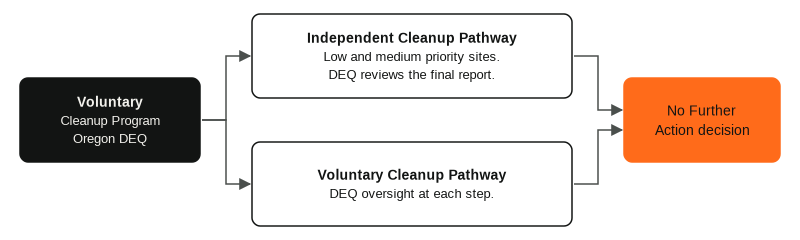
DEQ created the Voluntary Cleanup Program to give oversight to owners and others who want to investigate and clean up hazardous substance sites in a voluntary, cooperative manner. Sites range from a small area of contaminated soil to complex sites with many contaminants.
DEQ describes two options.
| Independent Cleanup Pathway | Voluntary Cleanup Pathway | |
|---|---|---|
| DEQ role | No ongoing oversight. DEQ reviews the final report. | Oversight through the investigation and the cleanup |
| Site priority | Low and medium priority sites only | High priority sites and lower priority sites |
| Deposit that DEQ lists | $1500 | $5000 |
| Result | NFA letter after DEQ reviews and approves the cleanup | NFA determination when protective conditions are achieved |
| Public notice | Required before the NFA | A public comment period is part of the process |
Independent Cleanup Pathway
The Independent Cleanup Pathway is for parties that want to clean up a site without ongoing DEQ oversight. You enroll through the Your DEQ Online system. You do the work with your consultant. Then you send a final report to DEQ.
DEQ’s information packet asks for notice 90 days before you submit the report. DEQ says this lets it complete the review within 60 days, and that this may vary with its workload.
Voluntary Cleanup Pathway
The Voluntary Cleanup Pathway is the original path. DEQ lists these steps:
- You complete the Cleanup Program Intake submittal and pay the deposit.
- DEQ staff assess the conditions at your site.
- DEQ works with you on a scope of work.
- You develop work plans and reports for DEQ approval.
- You propose a remedy, and DEQ evaluates it.
- You implement the remedy that DEQ selects.
- DEQ issues an NFA determination.
DEQ says this pathway has a flexible schedule. Work can be part of a site development project.
What DEQ charges
Oregon law requires responsible parties to reimburse DEQ’s costs. DEQ bills staff time plus indirect costs. DEQ’s invoicing page gives an estimated average hourly rate of $204 for employee time, including indirect cost, as of January 2024. Payments are due 30 calendar days from the invoice date. DEQ says a written estimate of oversight costs is available to parties in the Voluntary Cleanup Program.
Consultant and contractor costs are separate. See our remediation service for how a cleanup is planned.
The cleanup rules: OAR 340-122
The cleanup standards are in Oregon Administrative Rules (OAR) Chapter 340, Division 122. The rules set the standards and procedures for removal and remedial action after a release of a hazardous substance.
Oregon uses a risk-based approach. OAR 340-122-0115 defines acceptable risk levels. For one carcinogen in a deterministic risk assessment, the level is a lifetime excess cancer risk of one per one million or less. For multiple carcinogens, the cumulative level is one per one hundred thousand or less.
The rules also allow generic remedies. Under OAR 340-122-0047, DEQ can develop a preset remedy for a common type of site. Ask your consultant if one applies.
No Further Action decisions
DEQ makes an NFA decision after it determines that a site, or one part of a site, poses no unacceptable risks to human health or the environment. It means DEQ will not require more remedial action, based on what DEQ knows at that time.
Conditional NFAs
Some decisions rely on institutional or engineering controls that prevent exposure to contamination left in place. DEQ’s Cleanup Program calls these Conditional NFAs. DEQ says such controls are recorded on the property deed and must be maintained for the NFA to stay valid.
Read the letter
DEQ’s fact sheet gives clear advice to buyers and lenders:
- The NFA letter is the most important document to review.
- A tank program NFA usually applies only to contamination from the underground storage tank system. A Cleanup Program NFA usually applies to the whole facility.
- An NFA without the Conditional label does not always mean the site is ready for unrestricted use.
- DEQ may rescind an NFA in some cases, such as a newly found release.
DEQ also says an NFA does not release a current owner or a later purchaser from liability. Even so, DEQ calls it a practical approach for many purchasers.
Prospective Purchaser Agreements
A PPA is a legally binding agreement between DEQ and a prospective purchaser or lessee. It limits that party’s liability to DEQ for cleanup of the property. In return, the agreement must give the state a substantial public benefit.
DEQ lists four minimum requirements in the law:
- The buyer is not responsible for the existing contamination.
- There is contamination, and the law requires its cleanup.
- The buyer’s proposed use will not make the contamination worse or interfere with cleanup.
- A substantial public benefit will result.
Examples of a substantial public benefit include a commitment to do substantial cleanup, or productive reuse of a vacant commercial or industrial facility.
Timing and cost of a PPA
| Item | What DEQ says |
|---|---|
| When to negotiate | Before you acquire an interest in the property |
| Deposit | $2,500. Any balance is refunded when the PPA is done or talks stop. |
| Average time | Four to six months |
| After signing | You must record the PPA in the county office and meet all its conditions |
A PPA has limits. It does not protect against liability under federal law. It does not cover new contamination after you acquire the property. DEQ notes that a PPA runs with the land, so it can protect later owners that follow its terms.
Because of the time needed, raise the PPA question early in your due diligence period.
Regulated tanks: OAR 340-150
Many commercial sites have underground storage tanks. DEQ’s Underground Storage Tank Program covers tanks larger than 110 gallons that store gasoline, diesel, and similar regulated substances. The rules are in OAR Chapter 340, Division 150. Division 151 covers financial responsibility.
These rules matter in a purchase:
- Sellers. Under OAR 340-150-0140, a seller must notify the new owner in writing of the permit requirements. The seller must also transfer all documentation for the tank system.
- New owners. Under OAR 340-150-0052, the new owner or proposed new permittee must apply to modify the registration certificate within 30 days. The fee is $75.
- Tank closure. Under OAR 340-150-0168, notice to DEQ is due at least 30 days before permanent closure. A site assessment is required after removal.
- Suspected releases. Under OAR 340-150-0500, the owner and permittee must notify DEQ within 24 hours.
Cleanup of a petroleum release from a regulated tank follows OAR 340-122-0205 to 340-122-0360. The rules require a report within 20 days after release confirmation and site characterization information within 45 days. DEQ can approve a longer period.
For tank sites, see our UST removal and closure service and our page on gas stations.
How Oregon compares to Washington
Washington has its own cleanup law, its own program, and its own terms. Do not assume that an Oregon rule applies north of the Columbia River. Read our guide to the Washington Voluntary Cleanup Program if your portfolio covers both states.
Next step
Start with good data. A Phase I, and a Phase II if needed, tells you which DEQ option fits your site. Kee Enviro works on commercial property in Oregon, including Portland. Contact us to talk through your property and your closing date.