
A tank closure in Washington has fixed steps and fixed dates. The dates are in the state rule, chapter 173-360A WAC. If you miss one, your sale, loan, or project can slow down. This guide lists each step in order, with the deadline and the rule section for each one.
This guide covers commercial tank systems that chapter 173-360A WAC regulates, such as fuel tanks at gas stations and fleet yards. Ask your consultant to confirm that your tank is a regulated system.
The short version
- Send Ecology a notice of intent 30 to 90 days before the planned start date.
- Confirm the start date at least three business days before the work starts.
- Use a certified service provider to decommission the tank.
- Do a site assessment with soil samples around the tank, piping, and dispensers.
- Report the decommissioning and the site assessment within 30 days.
- Report a confirmed release within 24 hours.
Closure deadlines at a glance
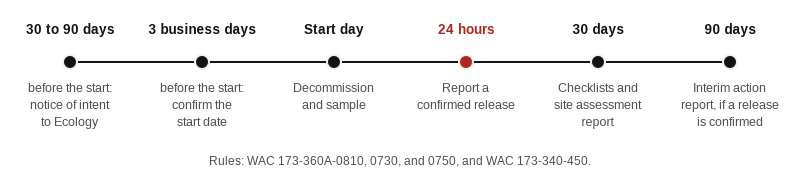
| Step | Deadline | Rule |
|---|---|---|
| Notice of intent to Ecology | At least 30 days, but no more than 90 days, before the planned start date | WAC 173-360A-0810(1) |
| Confirm the start date | At least three business days before the work starts | WAC 173-360A-0810(1) |
| Decommissioning checklist | Within 30 days | WAC 173-360A-0810(2)(c) |
| Site assessment checklist and report | Within 30 days | WAC 173-360A-0730(7) |
| Report a confirmed release | Within 24 hours of confirmation | WAC 173-360A-0750(1) |
| Initial site characterization | Within 30 days of release confirmation | WAC 173-340-450(5)(b) |
| Interim action report | Within 90 days of release confirmation | WAC 173-340-450(6) |
Step 1: Give notice of intent
Owners and operators must tell Ecology before they permanently close a tank system. The notice goes on the form that Ecology provides. It must arrive at least 30 days before the planned start date. It cannot arrive more than 90 days before that date.
There is a second date. You must confirm the planned start date with Ecology at least three business days before the work starts.
Step 2: Decommission the tank
The rule lists the actions that decommissioning must include, as they apply to your system:
- Empty and clean the tanks. Remove all liquids and sludge.
- Empty the piping. Remove all liquids.
- Remove the tanks from the ground, or close them in place. Closure in place means filling the tank with an inert solid material, or another manner that Ecology approves.
- Remove the piping from the ground, or close it in place by capping.
- Designate and dispose of the removed liquids and sludge under federal, state, and local requirements.
Who can do the work
Decommissioning must be done by, or under the direct supervision of, a certified service provider. WAC 173-360A-0930 lists the certifications. For decommissioning, one path is the International Code Council UST Decommissioning certification (U2). Site assessment is a separate certification. One path is the International Code Council Washington State Site Assessment certification (U7).
Ask each firm for its certification before you sign a contract. The rule puts this duty on owners and operators.
The decommissioning checklist
The service provider completes a checklist that Ecology provides. It must reach Ecology within 30 days. If no tank systems remain in operation at the facility, the facility compliance tag goes back to Ecology with the checklist.
Step 3: Do the site assessment
Permanent closure needs a site assessment around the system that you close. The assessment shows whether the tank released fuel to the soil or groundwater.
There is one exception. A site assessment is not required when a release was already confirmed and reported, and more cleanup work is necessary for that release. Ecology can direct otherwise.
The sampling and analysis plan
A sampling and analysis plan must be prepared for all sampling in a site assessment. The plan states the reasons for the assessment, the number and location of samples, and the methods. It also names the accredited laboratory. Ecology may require you to submit the plan at least 30 days before any sampling.
Minimum soil samples
Samples go where contamination is most likely. Table 0730-1 in WAC 173-360A-0730 sets the minimum number for removed systems.
| What is assessed | Minimum soil samples when removed |
|---|---|
| One tank under 9,000 gallons | Three samples |
| One tank of 9,000 gallons or more | Five samples |
| More than one tank in an excavation zone | Five samples for the first tank and two more for each added tank |
| Piping | One sample for every 50 feet of piping |
| Dispensers | One sample beneath each dispenser |
| Excavated soil, 0 to 25 cubic yards | One sample |
| Excavated soil, 26 to 50 cubic yards | Two samples |
| Excavated soil, 51 to 100 cubic yards | Three samples |
For piping, the table says to collect one sample if the run is less than 50 feet and two samples if the run is 50 to 100 feet. Larger soil piles need more samples, and the table lists those counts too. Tanks that are closed in place have their own counts in the same table.
If physical conditions prevent a required sample, the plan must explain why. An alternative sampling plan is then prepared.
When groundwater is sampled
Groundwater sampling applies when soil sampling has not confirmed a release and certain conditions exist. One condition is that the lowest point of the system is in groundwater. Another is that monitoring wells already exist at the facility and can give useful data. Ecology can also require it.
The service provider must be on site
The certified service provider must be present at the facility when and where the site assessment is done. The provider must also be present when tanks or piping are removed.
Step 4: Report the results
The site assessment must be reported to Ecology within 30 days. The submittal has two parts: the checklist that Ecology provides, and a report. The service provider completes both.
The report includes the lab reports, a table of results, and site diagrams with every sample location. It also gives a conclusion on whether a release occurred that may pose a threat to human health or the environment.
Keep the plan, the report, and the checklist. The rule requires these records until six years after the system is permanently closed.
Step 5: If the samples confirm a release
A release is confirmed when a soil result exceeds the level in Table 740-1 of WAC 173-340-900. For groundwater, the levels are in Table 720-1. If the substance is not in the table, a Method B level applies.
Then the clock is short.
- Within 24 hours. The service provider must notify the owner or operator immediately, and Ecology within 24 hours. The owner or operator must also report the release to Ecology within 24 hours of confirmation. The first response starts in the same 24 hours. It includes steps to prevent further release and to reduce fire, explosion, and vapor hazards.
- Within 30 days. The owner or operator must do an initial site characterization. It identifies the substances, the source, and the affected soil or water. It also checks the potential for vapors to enter buildings and utility vaults. If free product is found, removal must start no later than 30 days after confirmation.
- Within 90 days. The owner or operator must submit an interim action report to Ecology.
The site assessment report may be combined with the reports that WAC 173-340-450 requires. In that case, the combined report must be submitted within 30 days of release confirmation.
If the interim actions are not enough, more cleanup follows under the state cleanup law. Read about contaminated soil removal cost in Washington and our remediation service.
Where a petroleum tank cleanup goes next
Petroleum released from a tank system does not go to Ecology’s Voluntary Cleanup Program. The Pollution Liability Insurance Agency (PLIA) runs a Technical Assistance Program for these sites. It can issue a No Further Action opinion for a completed cleanup. Read how the PLIA Technical Assistance Program works.
How to keep a closure on schedule
- Put the notice window and the three business day confirmation on the calendar.
- Ask for the sampling and analysis plan before the dig starts.
- Ask who writes the checklist and the report, and when you will get them.
- Tell your lender and attorney about the 24-hour rule before the work starts.
A tank closure often happens during a sale or a refinance. Buyers and lenders may ask for the closure report. If a Phase I report listed the tank as a concern, read what to do when a Phase I finds a REC.
Next step
Kee Enviro plans and manages tank closures for commercial properties in Washington and Oregon. This article covers Washington rules only. See our UST removal and closure service, or contact us to talk through your site. You can also call our Federal Way office at 206-914-4989.